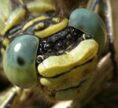

It is undoubtedly necessary first to explain why this Platycnemididae was given such a curious name: Coeliccia new sp. cf. nemoricola. It is quite simply a new species of Coeliccia very close (cf. for confer) to nemoricola.
Strictly speaking, and I am indeed surprised, sp. nov. for species nova (rather than "new sp.") should have been used, meaning "new species" rather than an English term. But the text (1) to which I am referring does not describe this new species, it merely mentions it, and thus undoubtedly escapes the strict requirements of international codes, of which Rory Dow, local and regional expert, is necessarily aware.


1 & 2 Sri Maha Mariamman Temple Matang, 20/03/2025 3- Mount Matang 23/03/2025
The problem is trying to figure out what distinguishes this species from C. nemoricola. I did find Laidlaw's description of this species, but nothing precise or obvious separates the two species, except: "Abdomen entirely dull black (in one specimen there is some trace of lighter colour on the dorsal side of segment 10)." Our subject shows not only an entirely pale blue S10 but also the apical 8/10ths of S9. Laidlaw described the species from a museum specimen, and at that time, collectors did not know how to properly preserve the colours of specimens.
To illustrate these colouration issues, he also wrote regarding the thorax: "an indication of a narrow antehumeral stripe on either side, of a dull black-purple colour, and of a band of similar colour at the base of the side of the thorax. During life it is possible that these bands are of a brighter colour. (une indication d'une étroite bande antéhumérale de chaque côté, d'une teinte terne violet foncé, et une bande d'une couleur similaire à la base du côté du thorax. Sur le sujet vivant, il est possible que ces bandes soient d'une couleur plus vive.)"
And of course, there is no description of our new species; otherwise, it would have been named.
I therefore do not know whether the anal appendages are different; Laidlaw did not provide a drawing of them.


If one wants to refer to the photos presented as C. nemoricola on iNaturalist, one must be cautious and verify that they were indeed taken in one of the areas where this species has been historically observed or one of the territories where it is officially known; this subject was actually photographed on Mount Kinabalu in Sabah.
I note the following differences: the mark on the pronotum is much more extensive, as is the one on S9, which is almost completely coloured and barely notched anteriorly, and the superior anal appendages appear distinctly shorter than in my photos.
In conclusion, there are at least 15 species of Coeliccia in Sarawak (80 in Asia); several species are currently being described, others are simply known, and certainly others remain to be discovered. It will therefore be necessary to revisit this page in a few years to learn the name of this species and to have more certainty about this genus.


Habitat of Coeliccicia new sp. cf. nemoricola
We encountered this species twice, on two rainy days, in the same type of habitat: a ditch heavily congested with vegetation draining small torrents, streams, and seepages of mid-altitude mountains, along a road or path providing a bit of light. It was found in the company of Coeliccia flavostriata and Stenagrion dubium, among others.


Taille

I usually give the size of the species I photograph by finding references in the literature, as I do not capture them; here, it is difficult, as the species has not yet been described.
So, we will settle for the size of C. nemoricola given by Laidlaw; the abdomen measures 50 mm, which makes a very fine damselfly of 60 mm!
I would like to remind you that the largest European damselfly, Chalcolestes viridis, only reaches 39 to 48 mm.

Coeliccia new sp. cf. nemoricola male, Sarawak, Sri Maha Mariamman Temple Matang, 20/03/2025
Geographical distribution
As long as the taxonomy is not established, its distribution range remains relatively uncertain; Dow (1) writes that Coeliccia sp. nov. cf. nemoricola is endemic to Sarawak and Brunei, whereas the nominal species, C. nemoricola, is reportedly found a bit further north, in Brunei and Sarawak.
Etymology of Coeliccicia new sp. cf. nemoricola
Selys described the first species of the genus in 1863 under the preoccupied generic name Trichocnemis (a longhorn beetle), and it was Kirby who corrected it and created the genus Coeliccia in 1890. This generic name, unexplained by the author to my knowledge, possibly comes from the Latin coelum (or caelum), meaning "sky" or "celestial", and a suffix or simple ending chosen for aesthetic or phonetic reasons. Indeed, the first species described by Selys, Trichocnemis membranipes, is sky-blue in all its non-black parts.
Nemoricola, from the Latin nemus for "wood" or "forest" and the suffix -cola indicating "inhabitation" or "dwelling", to signify that this species is found in forests.


1- Dow, 2021 – AN ANNOTATED CHECKLIST OF THE ODONATA (INSECTA) KNOWN FROM SARAWAK WITH RECORDS TO DISTRICT LEVEL – Sarawak Museum Journal · January 2021
2- Laidlaw, 1912 – List of the Odonata taken on a expedition to Mt. Batu Lawi together with description of supposed new species – Journal of the Straits Branch of the Royal Asiatic Society, No. 63 – P. 95.