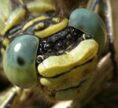

In Borneo, it was the fourth time I had encountered Onychargia atrocyana, but it was still a discovery for me in two ways: I had never seen an isolated male (which is surprising) outside of a tandem, and I had never been able to observe the blue reflections that give it its species name.
This Platycnemididae (or Coenagrionidae; I am not certain whether its assignment to one family or the other is definitively settled, due to larval morphology (1)) belongs to a genus containing only two species; another species was indeed recently described by Oleg Kosterin (2) in 2015, Onychargia priydak, which occurs in Cambodia and southern Vietnam and is characterised by very extensive pruinosity on the thorax and the first two segments.
Its thorax is so massive, and its dark colour makes adult males virtually impossible to confuse with any other species within its range. The pale thoracic stripe tends to vanish in fully mature individuals, while what appears as a purplish antehumeral stripe is a most welcome reflection.

It measures 30 to 32 mm (3).
Its habitat consists of ponds or heavily vegetated pools with marshy edges, often on the margins of forests.
Mature males tend to perch high in the vegetation, several meters above the ground, which explains why they are less frequently observed outside of reproductive activity. However, many photos of young males and females can be found on iNaturalist, which are likely wandering or maturing in low vegetation.
It is described as a fairly common species, but this was only the fourth time I had encountered it; as mentioned earlier, it was the first time I had observed isolated males (with no females around!), and I have never seen more than 3 or 4 individuals at a single site.

Above, a younger individual with a spectacular pale thoracic stripe.
Its distribution extends from central India to southern China (Yunnan) and southwards through the Malay Peninsula and Singapore to Sarawak, Sabah, and the Philippines.
Rather poor photos can be found on the pages I previously dedicated to the species in Cambodia and in continental Malaysia, and a lot better in Thailand.
IUCN Red List.
Etymology of Onychargia atrocyana
Onychochargia, from the Greek "onycho", meaning "nail" or "claw", and "argia", a South American zygopteran genus (whose name had previously been created as a variation of Agrion). In describing the subgenus Onychochargia, Selys (4) emphasises the tarsal claws: "the two branches of the tarsal claws as long as one another" – "The tarsal claws very singular, as in dragonflies of the genus Macromia". Furthermore, he describes this genus right after Argia, thinking it belongs to a subgenus of the latter (note also the density of the leg spines, which indeed recall the genus Argia).
Atrocyana, from the Latin "atrum" for "black" and the Greek "kuanos" for "dark blue". Selys, describing a very adult specimen, wrote, "Entirely of a steel violet black without any spot".
It appears to have a short abdomen, as noted by various authors; in English, it goes by the name of Shorttail! But also Marsh Dancer ("Dancer" being, in fact, the English genus name for Argia) or Black Marsh Dancer.
1- ORR & DOW, 2015 - Description of the final stadium larvae of Onychargia atrocyana Selys, 1865 from Sarawak, identified using DNA barcoding (Odonata: Zygoptera: Platycnemididae),with an overview of larval characters in the Platycnemididae - Zootaxa 4040 (3): 384–392.
2- Kosterin, 2015 - Onychargia priydak sp. nov. (Odonata, Platycnemididae) from eastern Cambodia - International Journal of Odonatology 18(2)
3- Robin Ngiam & Marcus Ng - A photographic guide to the Dragonflies and Damselflies of Singapore - John Beaufoy Publishing – 2022.
4- Selys, 1865 - Synopsis des Agrionines suite 1 - Bulletins de l’Academie royale, des lettres et des beaux-arts de Belgique - P. 416.