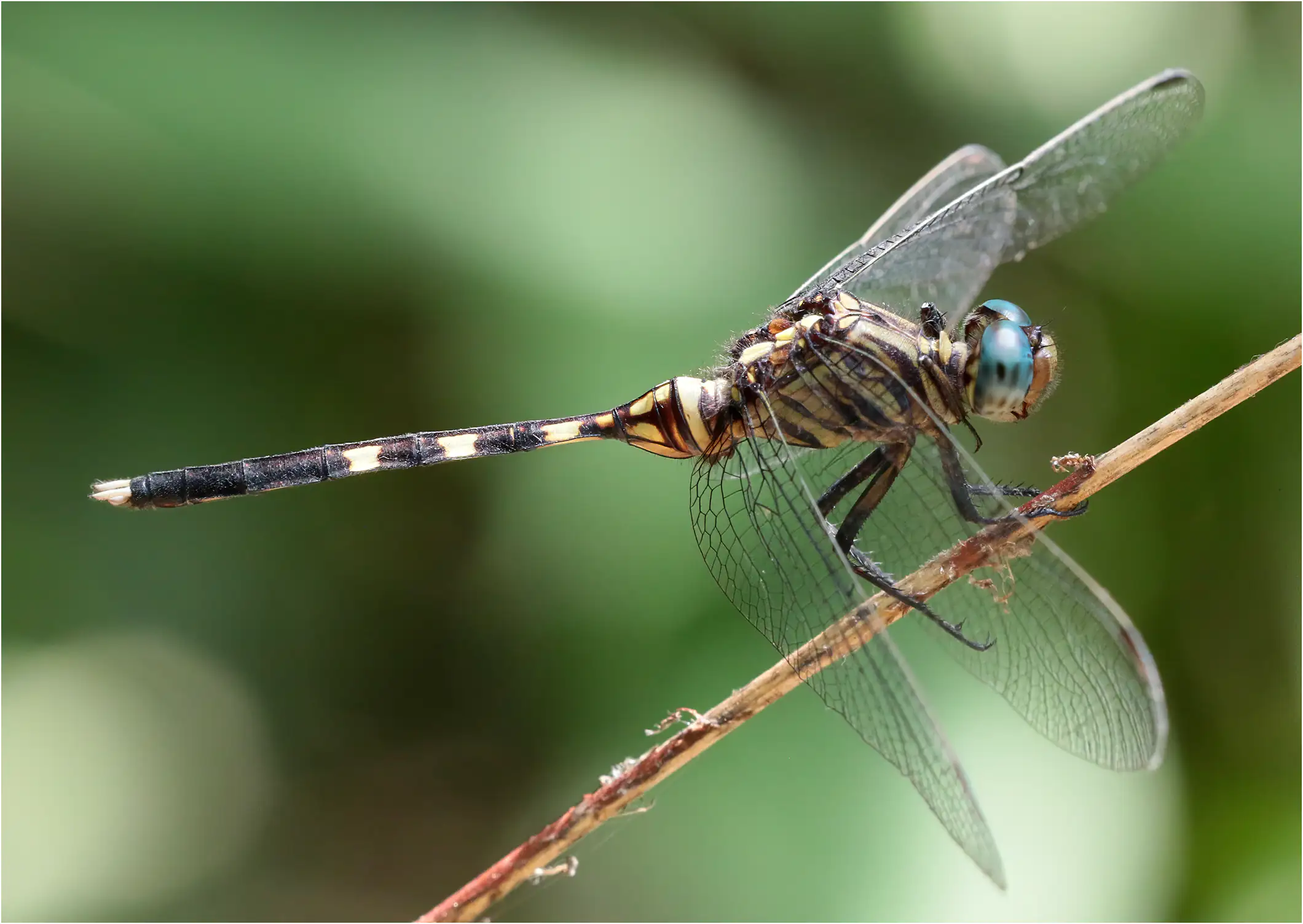
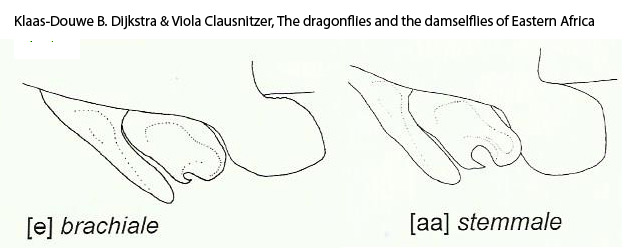
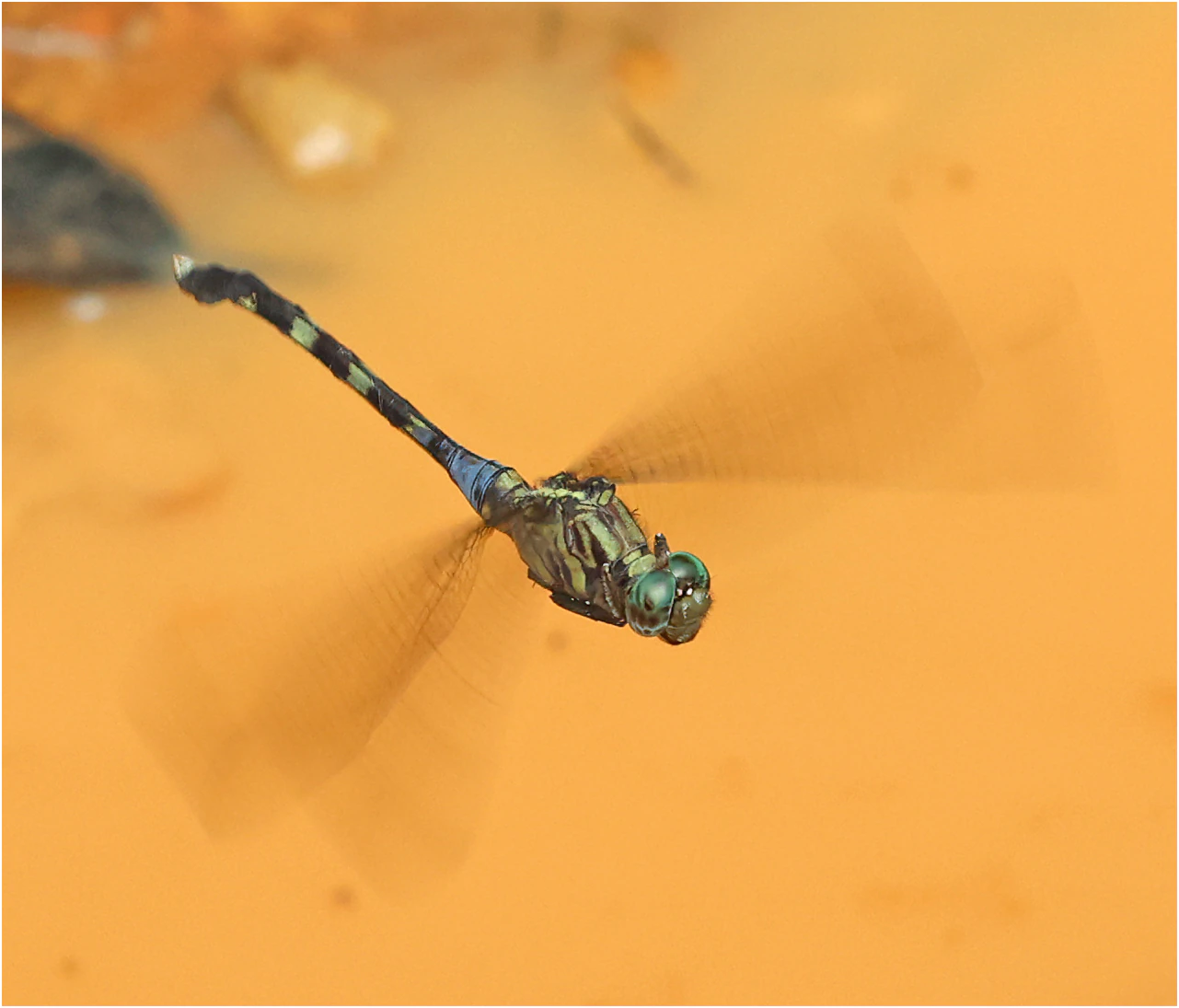
The male Orthetrum stemmale is apparently very common along forest paths, even though fully pruinose and mature individuals are rarely encountered. And fortunately so, because when they are adorned in blue like this, they are almost indistinguishable from O. brachiale and closely resemble O. julia. Personally, I find that the secondary genitalia under (S2) in O. stemmale and O. brachiale are very similar and require extremely good photos.
Even though, in the end, I don't think I saw O. brachiale in Ghana (two of us have a photo of a female), we still have to rule out that possibility every time.
Identification of Orthetrum stemmale
Identification is much easier for individuals whose abdomen, which bears a fairly specific pattern, is not pruinose, as one can note that the final segments of O. stemmale show more black coloration, extending slightly higher up the abdomen; segments 7 to 10 are completely black (only S8 to S10 and the distal end of S7 for O. brachiale). The black markings on the other segments are also visibly more extensive. Below is a montage I made while identifying my photos from Namibia:
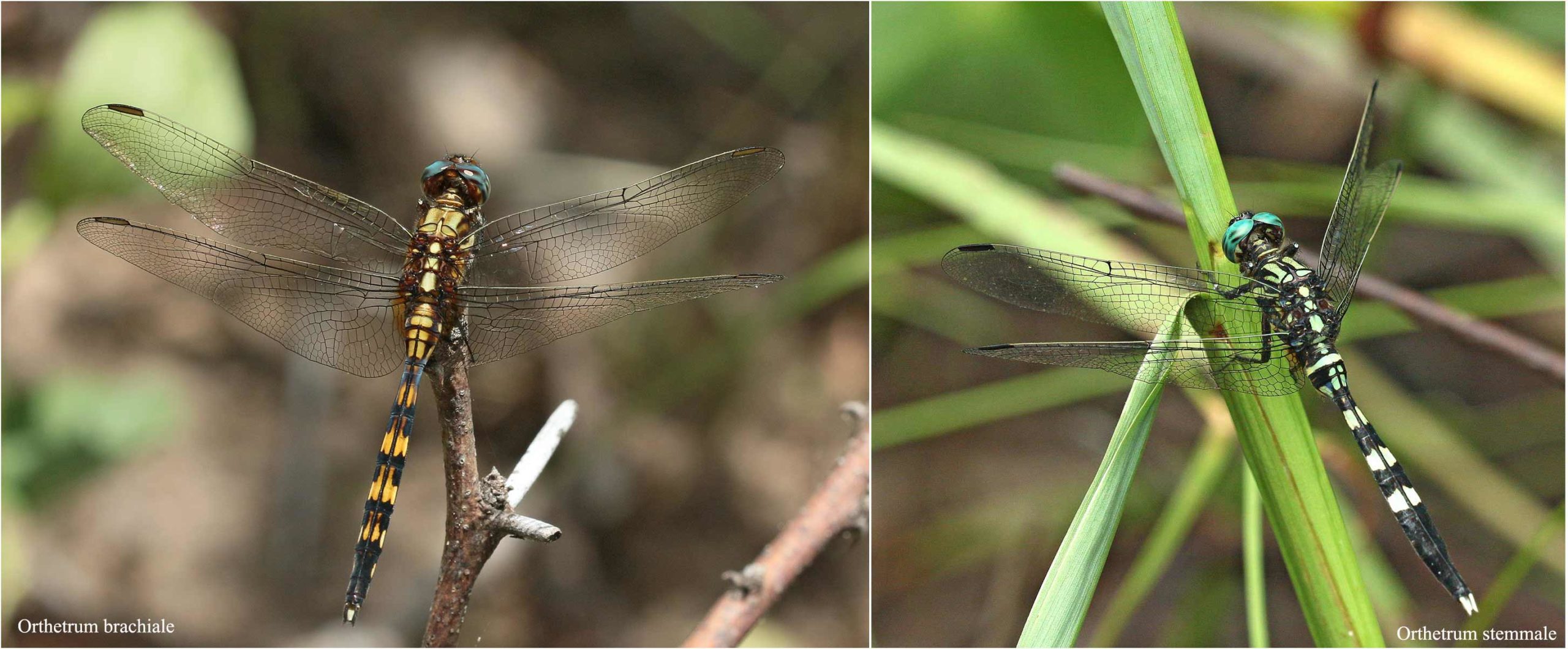
But this photo also shows two other very interesting identification details:
- The subcostal cross-veins of O. brachiale are pale; those of O. stemmale are black most of the time (except in a few geographic regions (ADDO, 2019)).
- The upper anal appendages, the cerci of O. brachiale are black, whereas those of Orthetrum stemmale are white or pale. However, they darken as they age, though never turning black, sometimes becoming pruinose blue like the abdomen.
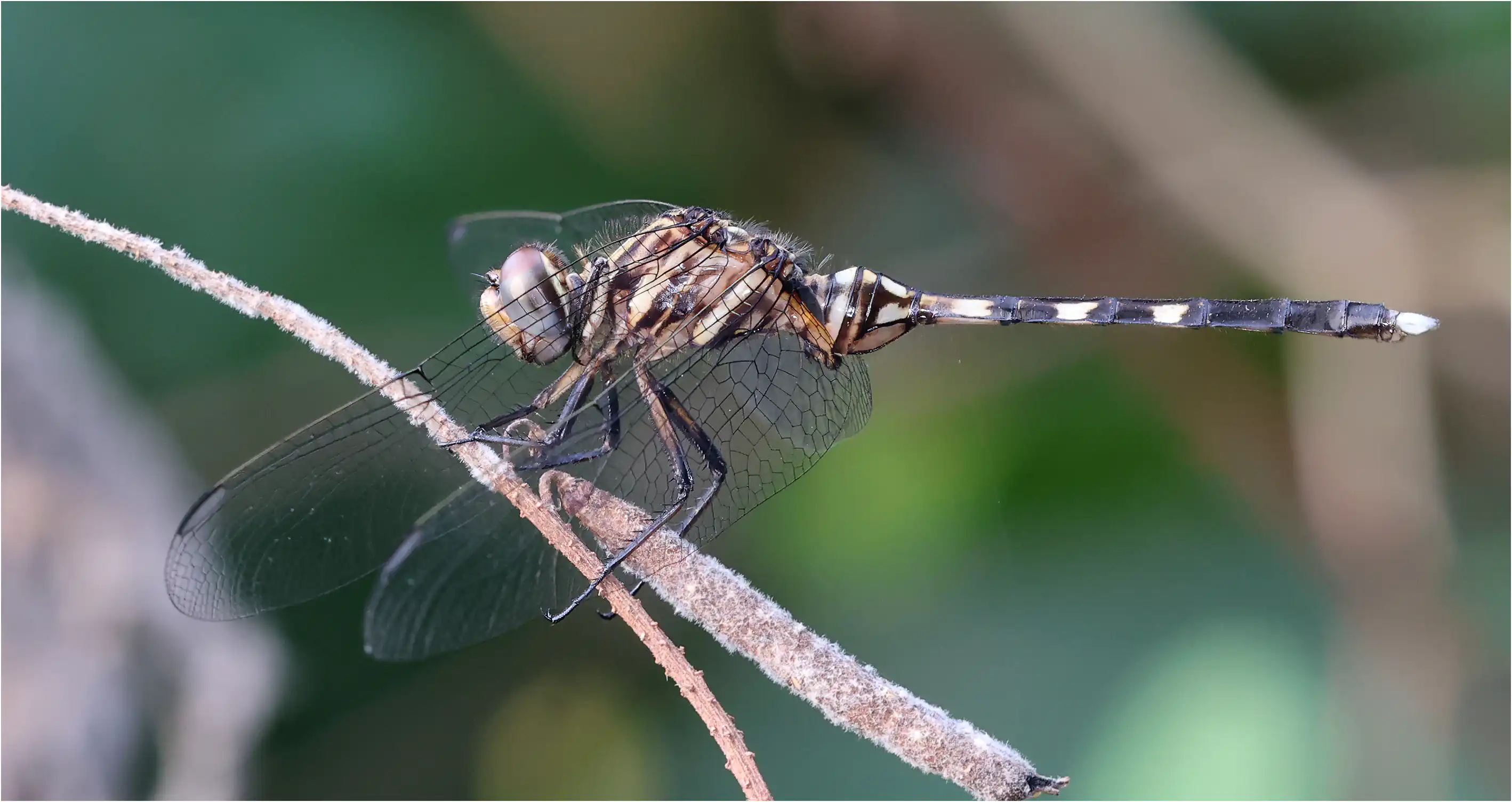
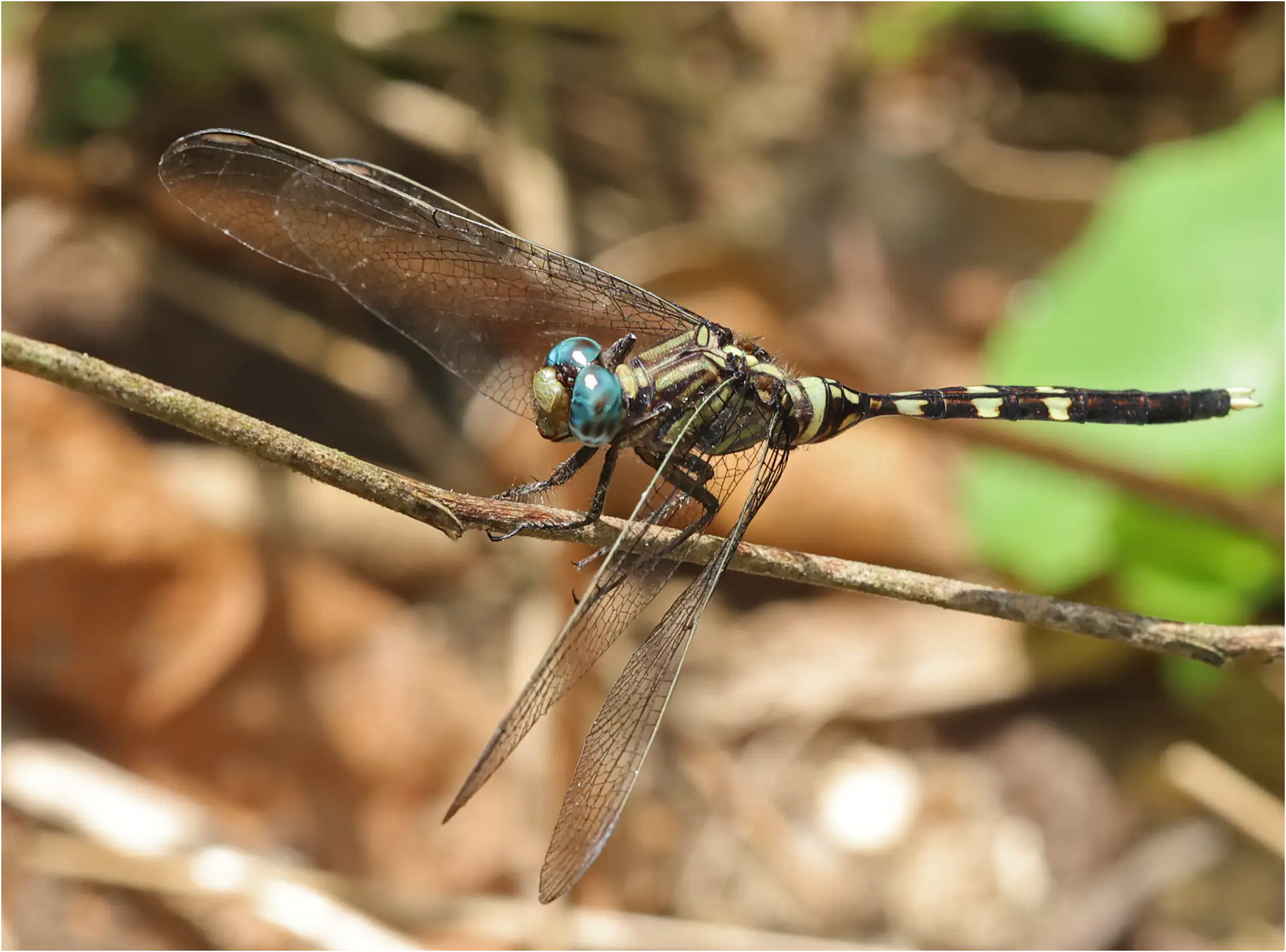
When pruinose, they are also close to O. julia, from which they are distinguished by the fact that the latter shows black pterostigmas and that its supplementary radial field (radial planate) does not contain double cells, unlike O. stemmale (and brachiale).
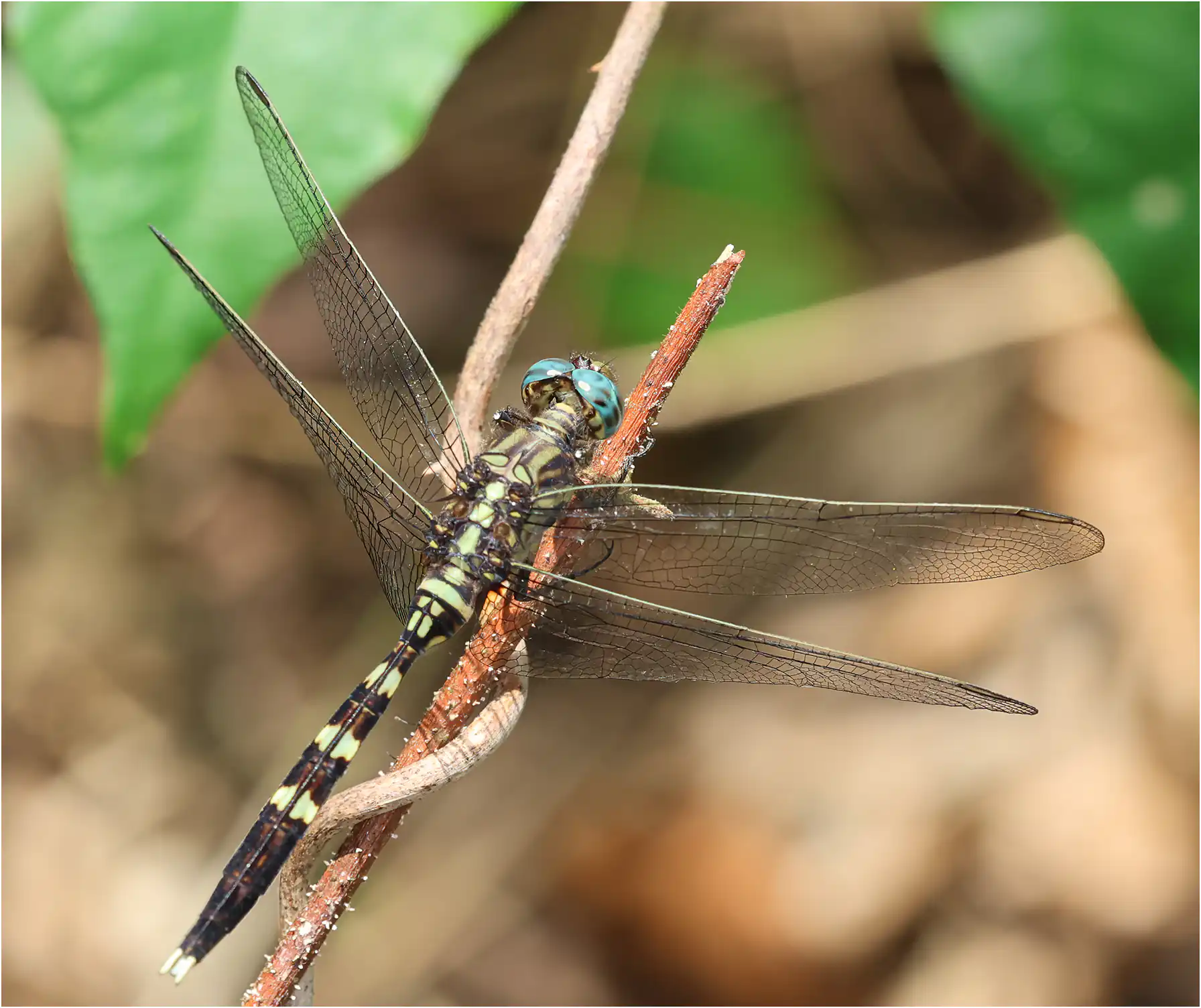
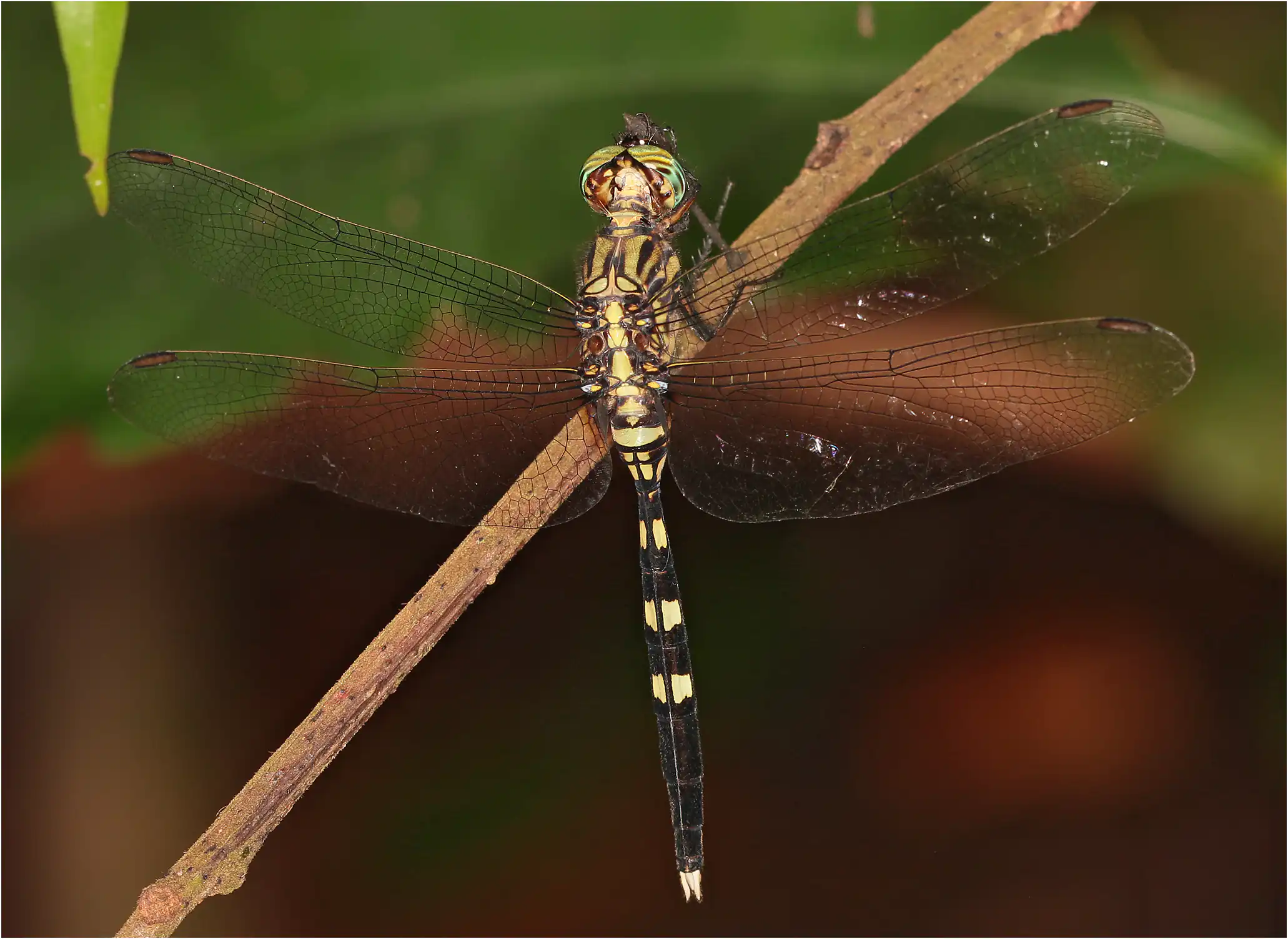
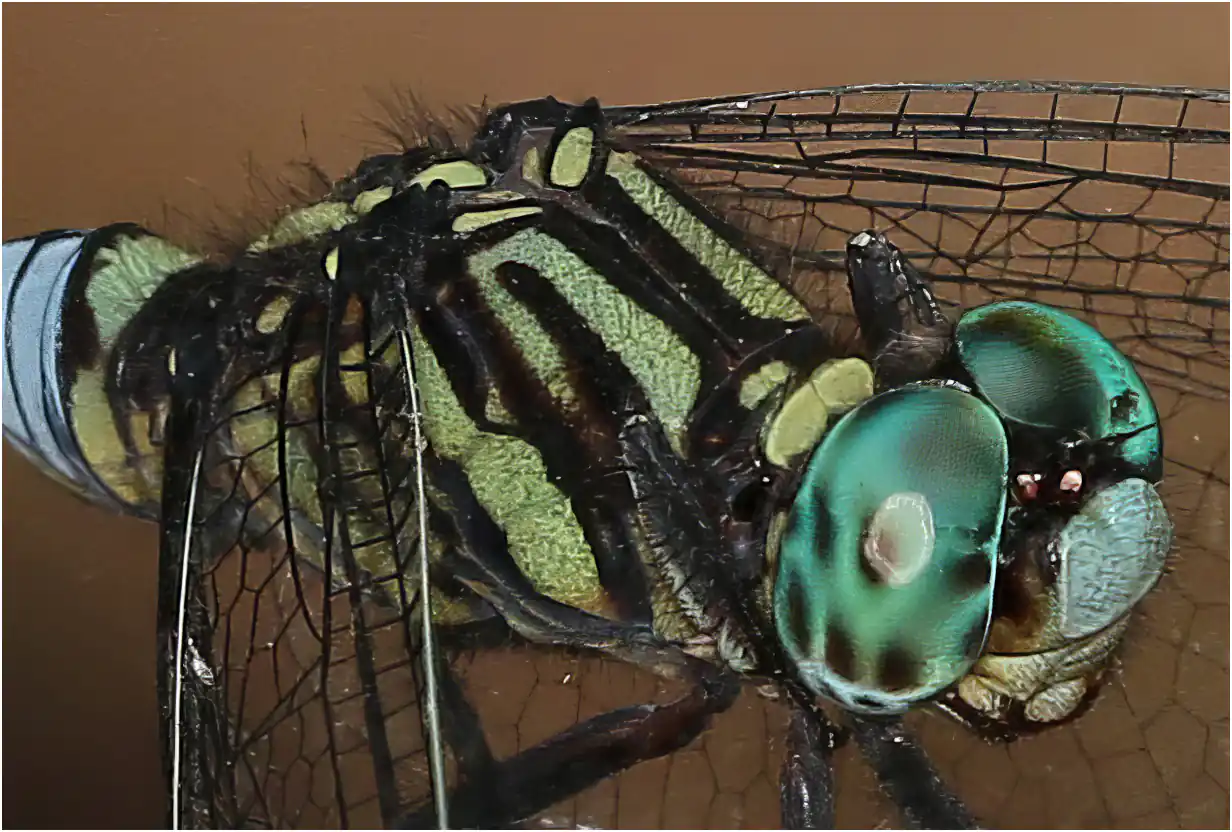
The male Orthetrum stemmale bears a well-defined, trident-shaped pattern on the anterior part of its thorax; unfortunately, O. brachiale does too, but its pattern is very indistinct and its lines are poorly defined. Longfield (1955) notes another difference (clearly visible below) between these two species: the "yellow center of the frontal shield completely encircled by black or very dark" for O. stemmale, which is very faint or absent in O. brachiale (here in Namibia). Longfield also includes the difference in coloration (white/black) of the subcostal cross-veins, which are distinctly black here.
According to Tarboton (2015), in South Africa, it measures 43 to 50 mm (43 to 57 mm for O. brachiale).
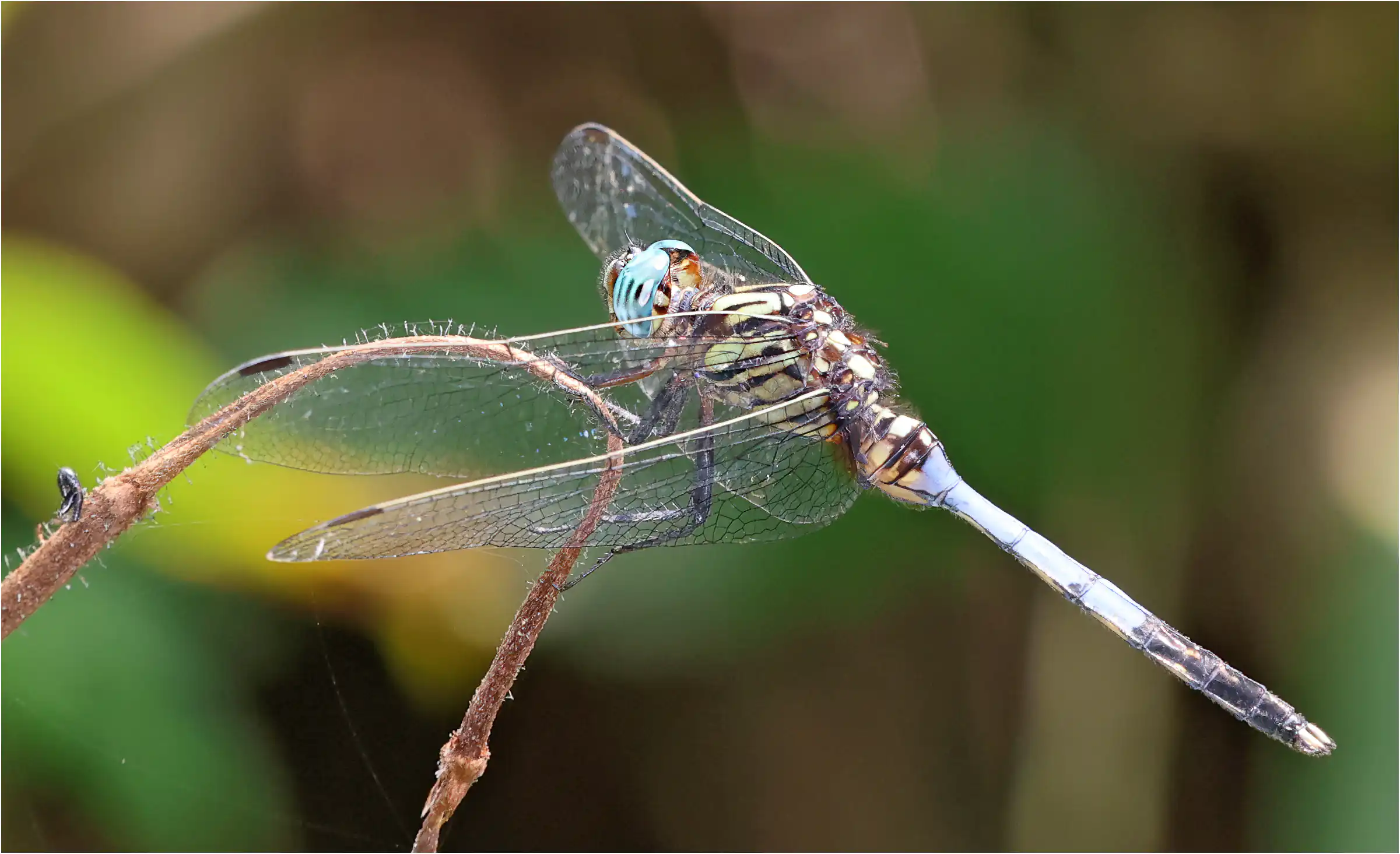
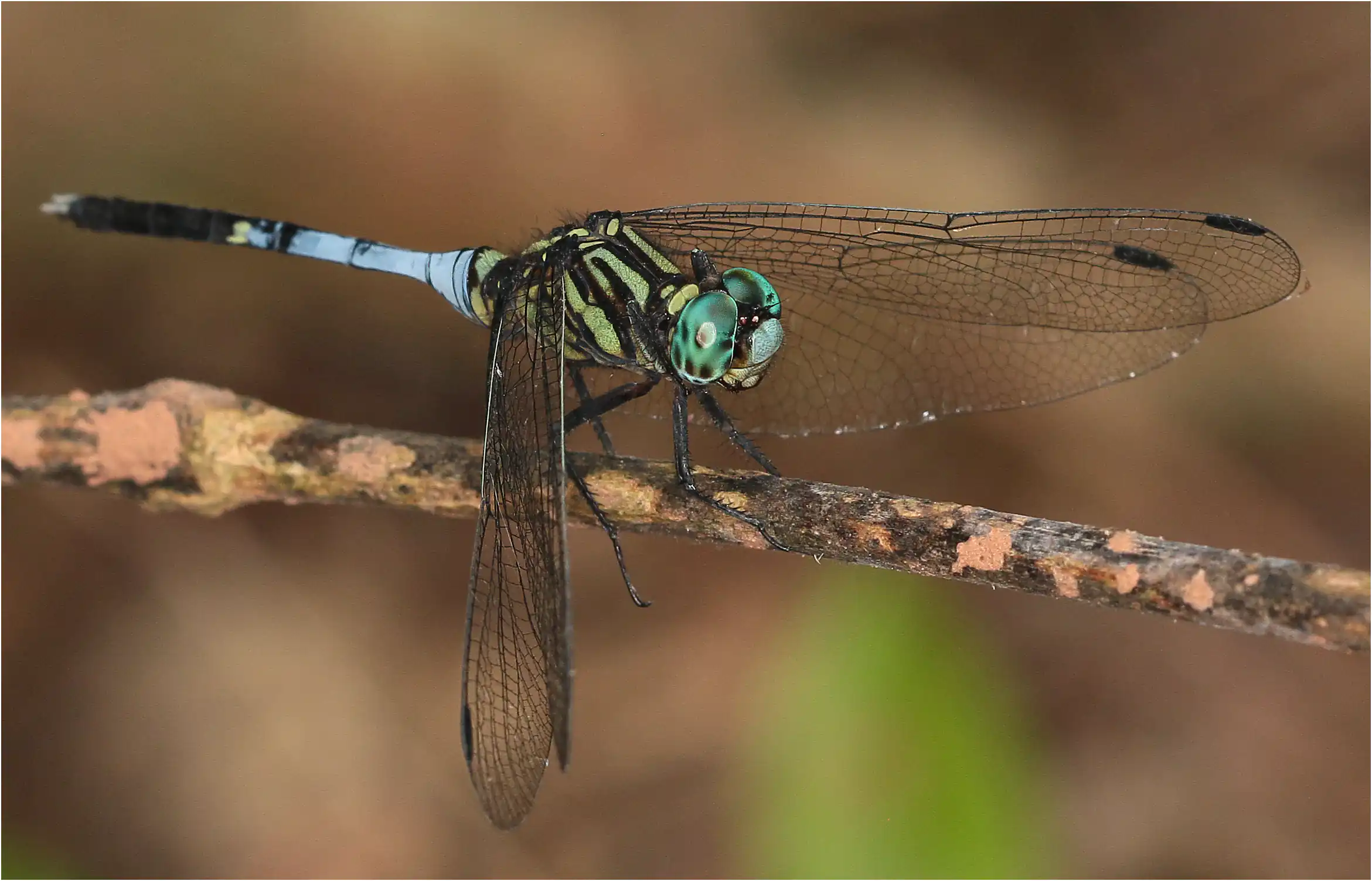
Below are two maturing males, whose bluish pruinescence still leaves the last four segments black.
Here is the English translation:
And finally, I will only present this fully blue male with enough confidence to state that it is indeed Orthetrum stemmale: note the abdomen moderately constricted at S3, then its fusiform shape; the anal appendages, bluish yet pale; the black coloration showing through on S7 to S10; the black subcostal cross-veins; the doubled cells in the supplementary radial field; and the extensive blue coloration between the wings and on the wing bases.
I had encountered immature males in Namibia, in an area where O. brachiale is absent, and in Réunion—where it is the sole representative of its genus—both mature and immature males.
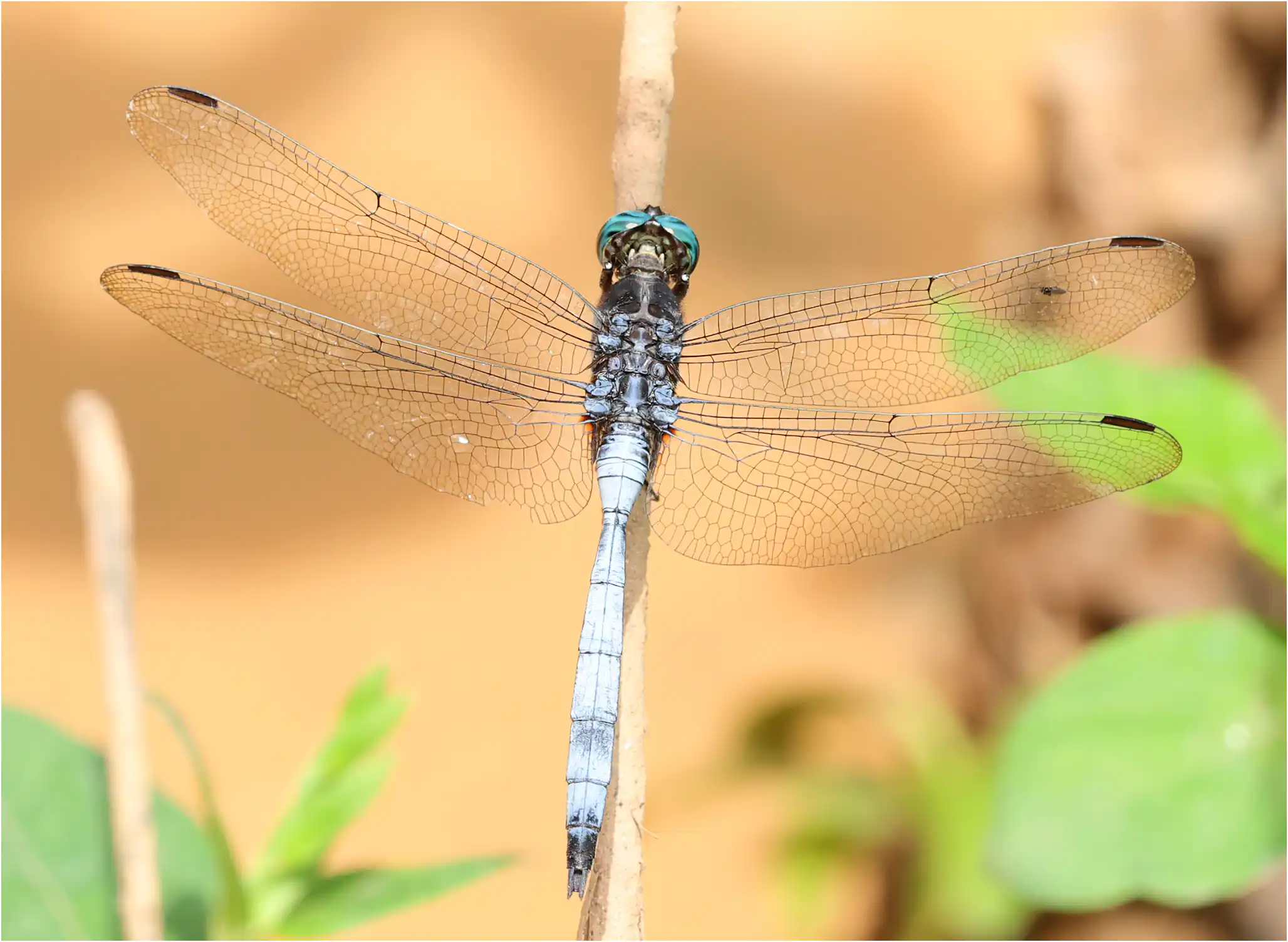
Females display the same abdominal patterns, almost as extensive on segments S7 to S10, white anal appendages, black subcostal cross-veins, and the trident pattern on the anterior part of the thorax. Note the ventral expansion of S8, which plays a role in oviposition by scooping up water drops alongside the eggs to prevent them from drying out.
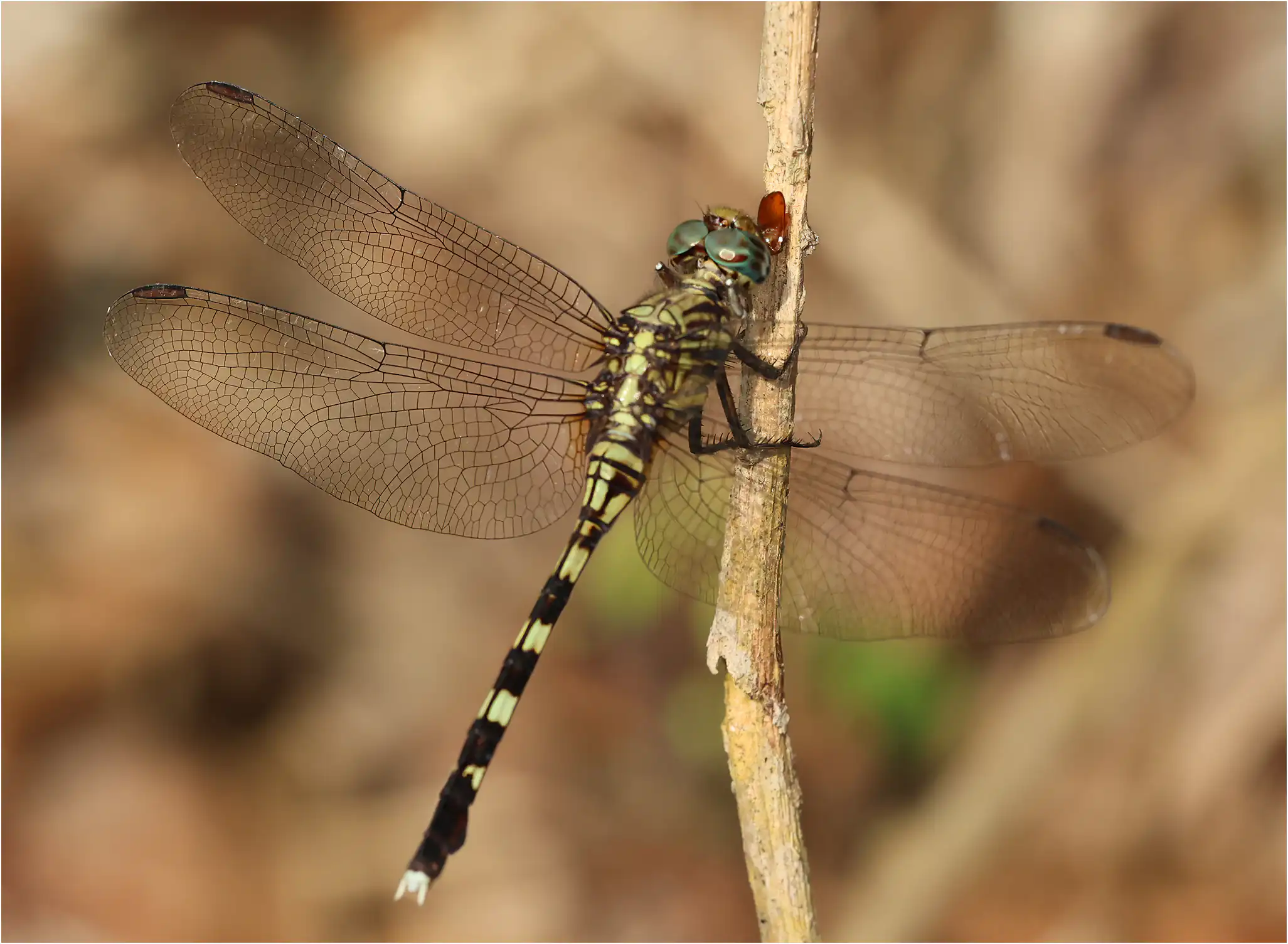
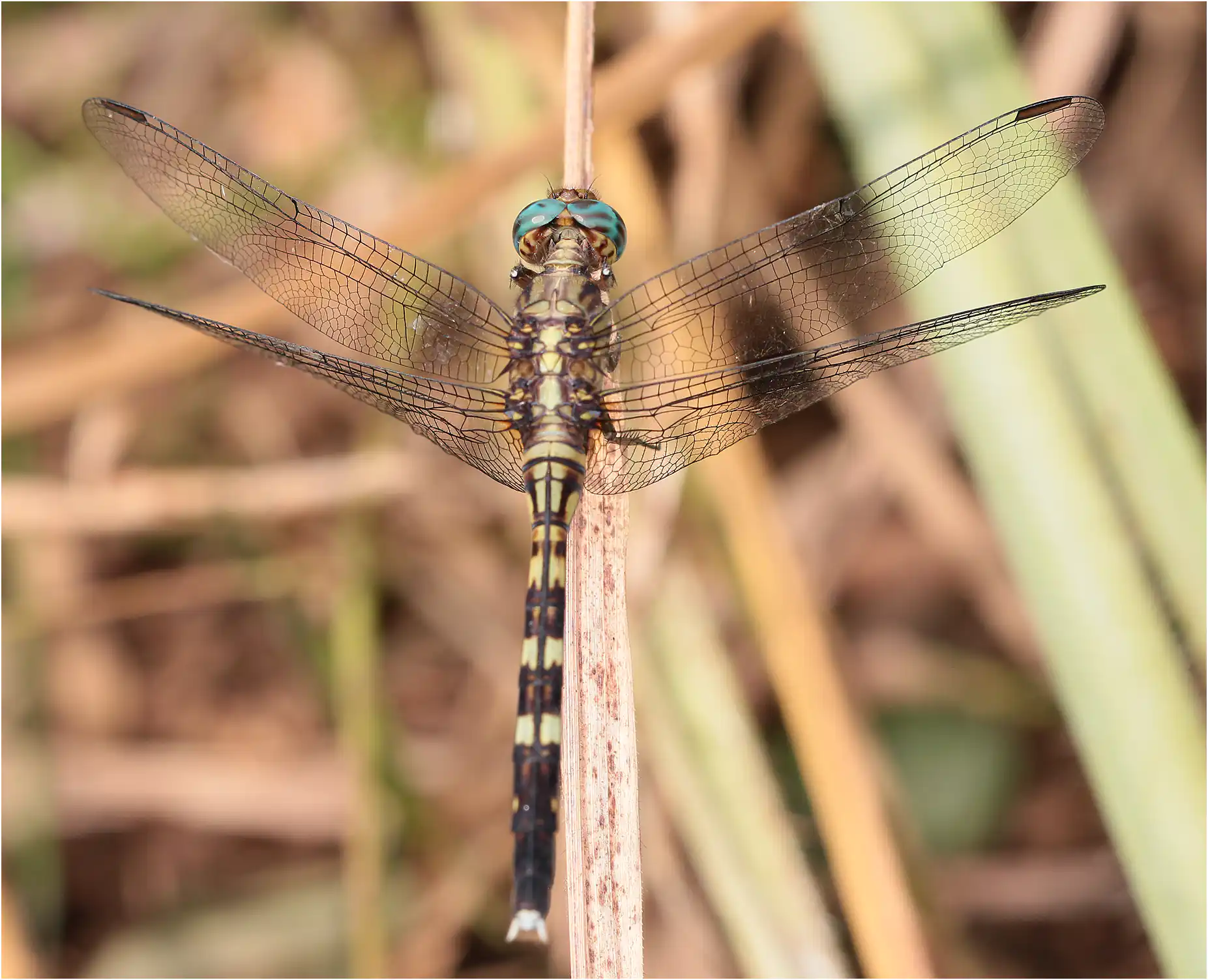
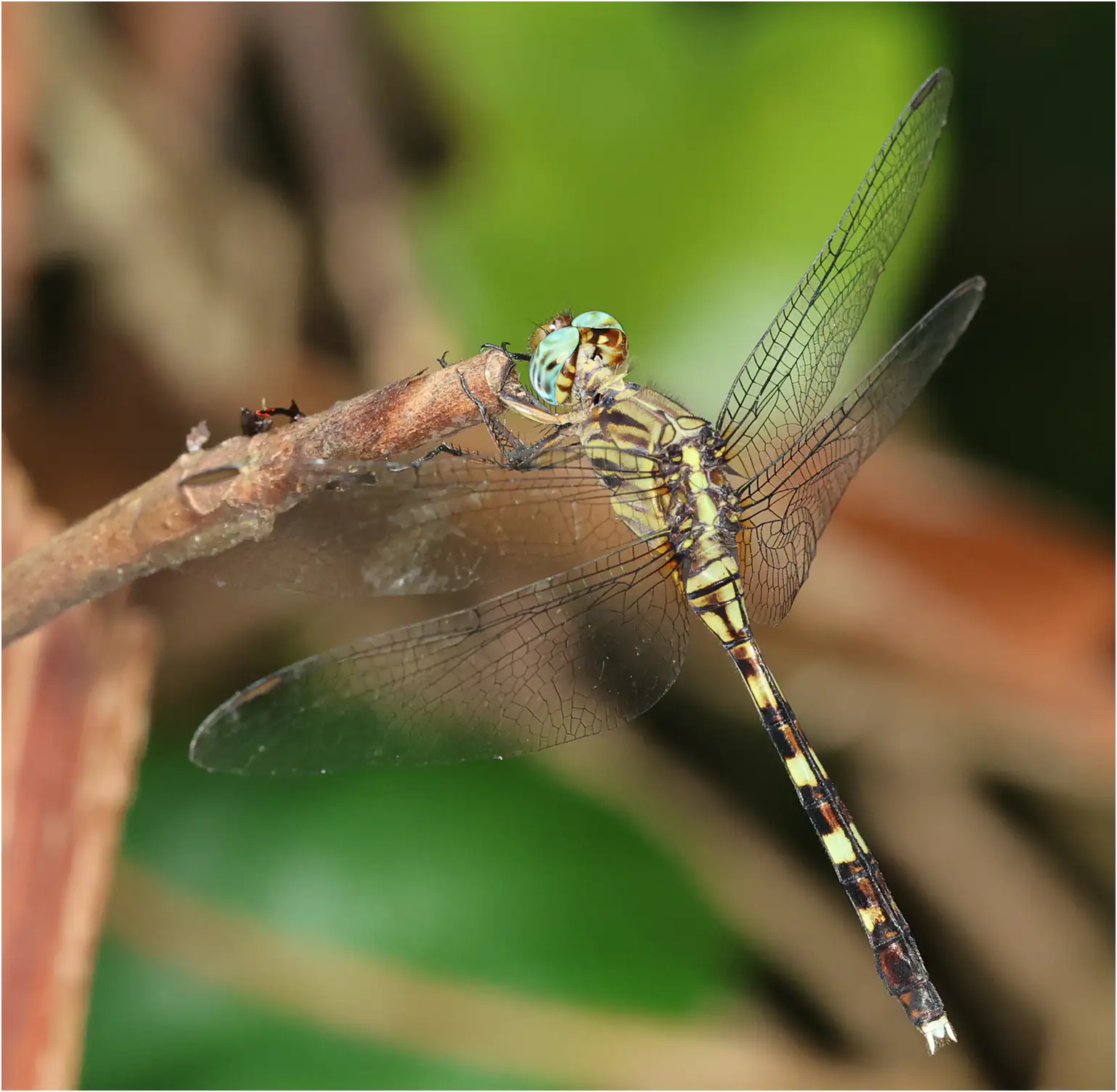
Note on the female above on the right the faint pale traces on a few subcostal cross-veins, which aligns well with the possible variation mentioned earlier.
| Separating O. stemmale / brachiale | Orthetrum stemmale | Orthetrum brachiale |
| Superior anal appendages cerci) | White or pale | black |
| Subcostal cross veins | black | pale |
| 7° abdominal segment | whole black | only distally black |
Habitat
We encountered them—at least all the non-blue individuals—along forest trails, thus in open, sunny areas, often around large and deep puddles left by the rain. They are said to appreciate muddy bottoms and also thrive on river pools.
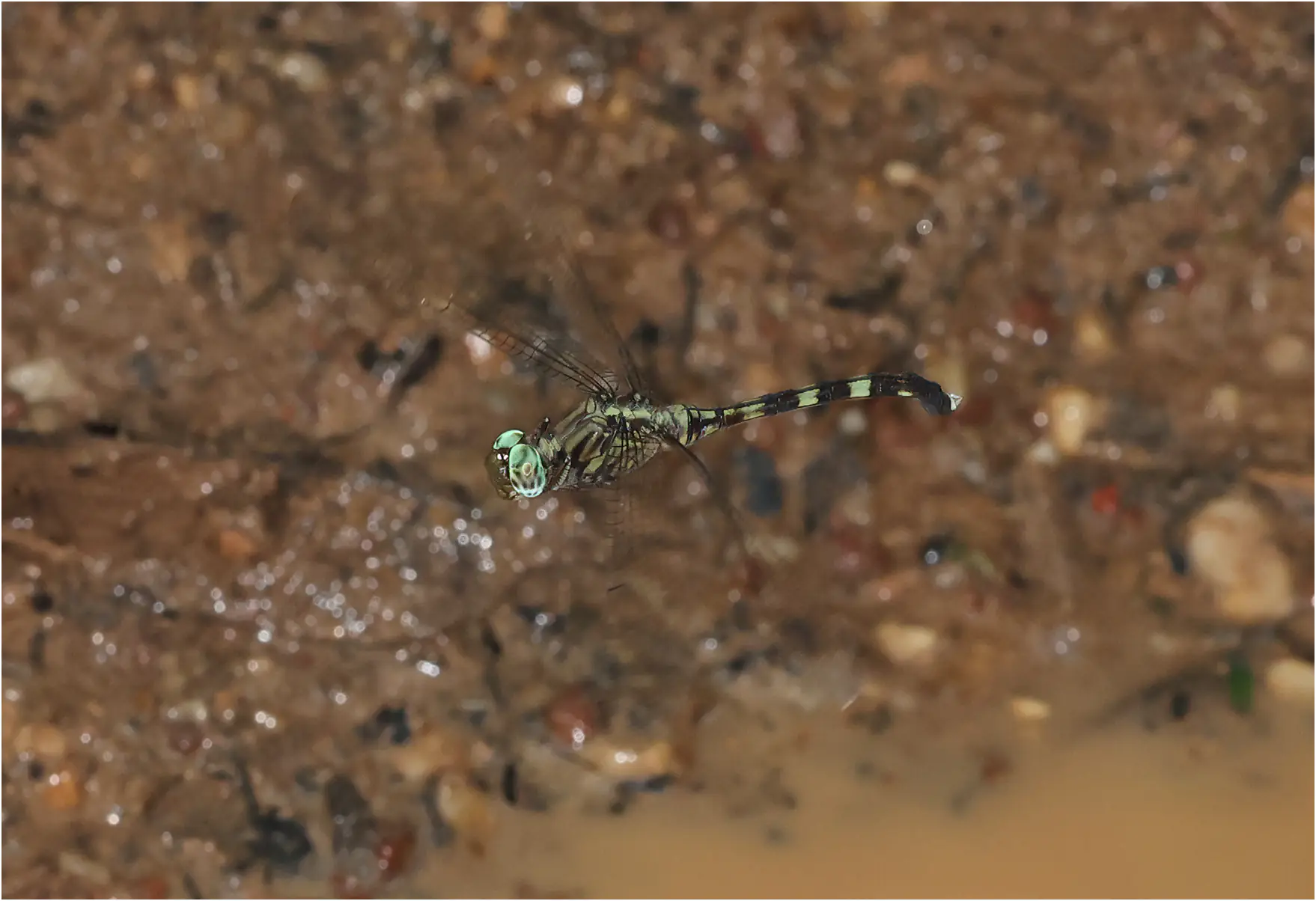
Note on the female above on the left the blue pruinescence on the first abdominal segments, which is unusual; and the trident pattern on the anterior part of the thorax.
Geographic distribution
Its distribution covers much of southern Africa, from Senegal and Guinea to Somalia. To the south, it reaches eastern South Africa, Madagascar, and Réunion.
To the west, its distribution extends from Cameroon to Angola, reaching the Caprivi Strip in Namibia.
IUCN Red List.
Étymology of Orthetrum stemmale
Orthetrum (see Endersby & Fliedner, 2015) comes from two Greek words, orthos meaning straight and etron for abdomen, to indicate that the sides of the abdomen are parallel. This (neuter) genus name created by Newman in 1833 lost its relevance with the discovery of new species (whose abdomen sides are not parallel), but the name remained.
Stemmale, from the Latin stemma meaning garland, crown, and the suffix -alis meaning provided with. Suhling and Martens (2007) suggest the following interpretation: "The species bears a crown-shaped mark consisting of a yellow spot on the upper surface of the frons, surrounded by black." This recalls Longfield's (1955) description reported above.
In English, which is not surprising given its vast distribution, it is called by several names. The official one adopted by ADDO is Bold Skimmer, which emphasizes the contrasting patterns of its youth. But it is also called Tough Skimmer (notably in South Africa) and even Strong Skimmer for its robustness.
Burmeister, 1839 - Handbuch der Entomologie (vol. 2) p. 857.
Endersby Ian & Fliedner Heinrich (2015). The Naming of Australia’s Dragonflies. Busybird publishing.
Klaas-Douwe B. Dijkstra & Viola Clausnitzer, 2014. The Dragonflies and Damselflies of Eastern Africa - Handbook for all Odonata from Sudan to Zimbabwe – Studies in Afrotopical Zoology, vol. 298 – Tervuren : Royal Museum for Central Africa
Dijkstra, K.-D.B. (editor, 2019). African Dragonflies and Damselflies (ADDO).
Longfield, C. (1955). The Odonata of N. Angola. Part I. Publicacoes culturais Companhia Diamantes Angola, 27, 11-63, p. 19.
Frank Suhling & Andreas Martens (2007). Dragonflies and Damselflies of Namibia. Gamsberg Macmillan.
Warwick et Michèle Tarboton (2015). A Guide to the Dragonflies & Damselflies of South Africa. Struik Nature.